

Certified 48Gbps HDMI 2.1 for consoles and AV rigs — future-proof performance with a minor flexibility trade-off.
If you want flawless 4K@120Hz or 8K@60Hz performance from your PS5 or streaming box, the weakest link is often the HDMI cable — dropped frames, HDR glitches, or no signal at all when bandwidth spikes. You need a cable that actually sustains the full 48 Gbps HDMI 2.1 spec so your display, console, and AVR talk to each other without compromise.
The Highwings 10K 8K HDMI 2-Pack promises exactly that: certified 48 Gbps throughput with support for 8K@60Hz, 4K@120Hz, eARC, HDCP 2.2/2.3, Dynamic HDR and DTS:X. It’s a practical, value-focused solution if you’re building a console setup or media rig that demands high refresh rates and modern AV features — though its rugged build does make it a bit stiff for tight runs.
Highwings 48Gbps HDMI 2.1 6.6FT 2-Pack

You get a reliable, future-proof HDMI 2.1 solution that delivers full 48 Gbps bandwidth for high-resolution, high-refresh applications. While it isn’t the most flexible cable for tight routing, you’ll appreciate the durable build, modern AV features, and the value of a two-pack for consoles and media rigs.
- Bandwidth & Signal Integrity – 9.5
- Build Quality & Durability – 8.5
- Gaming & AV Feature Support – 9
- Value & Compatibility – 9
Pros
- Full HDMI 2.1 feature set with full bandwidth for high-res/high-refresh workflows
- Supports 8K@60Hz and 4K@120Hz plus eARC and Dynamic HDR for modern AV use
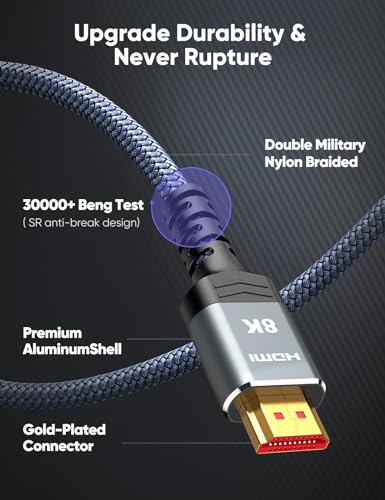
- Durable braided jacket and reinforced connectors with anti-bend tail design
- Two-cable pack gives flexibility for multiple devices or neat cable routing
- Good price-to-performance — certified 48 Gbps without premium-brand markup
Cons
- Sturdy construction makes the cable a bit stiff for tight bends or concealed runs
- No angled or ultra-low-profile connector options for crowded port layouts
Overview — What this cable brings to your setup
If you want to push a console, PC GPU, or UHD player to its limits without reworking your entire AV chain, this Highwings Ultra High Speed HDMI cable pair gives you a straightforward path. The product is built to carry the full HDMI 2.1 feature set and the accompanying bandwidth so you can take advantage of higher resolutions, higher frame rates, and advanced audio features in your living room or studio.
Design and materials — how it’s put together
The cable uses a braided nylon jacket with an aluminum alloy connector shell and a reinforced anti-bend tail at each end. That combination targets longevity and abrasion resistance while providing strain relief where connectors typically fail.
- Braided nylon outer jacket for abrasion resistance and tangling control
- Aluminum-alloy connector shells to resist deformation and shielding wear
- Integrated anti-bend tail to protect the solder joints at high-flex zones

Performance fundamentals — bandwidth, video and audio features you can rely on
This cable is engineered around the HDMI 2.1 Ultra High Speed spec so it supports the practical features you’ll actually use in 2024 and beyond: higher color bit-depths, Dynamic HDR metadata, low-latency audio passthrough, and variable refresh support for gaming.
| Feature | What it enables | Typical use case |
|---|---|---|
| Full 48 Gbps raw bandwidth | Stream uncompressed video at high frame rates and color depths | 4K@120Hz gaming with HDR or 8K@60Hz media playback |
| VRR (Variable Refresh Rate) and ALLM | Reduced stutter and automatic low-latency mode | Console and PC gaming |
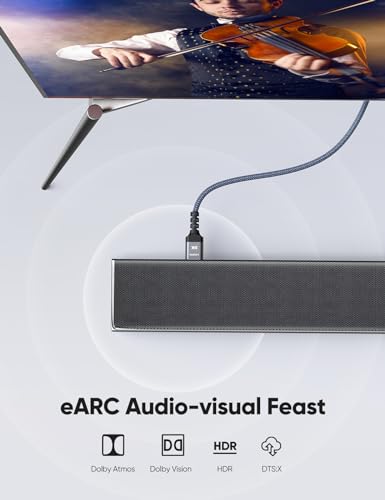
| eARC / Dolby/DTS passthrough | High-bitrate lossless audio to receivers/soundbars | Atmos-enabled AV setups |
| HDCP 2.2 & 2.3 compatibility | Protected content playback from modern streaming boxes | 4K/8K streaming services and UHD Blu-ray |
Real-world signal behavior and routing notes
Because you’re working with a cable that prioritizes shielding and robust conductors for 48 Gbps signaling, expect slightly greater stiffness compared with ultra-thin ‘micro’ cables. That stiffness is a trade-off: it reduces EMI susceptibility and improves long-run stability but can make tight cable trays and behind-TV routing more demanding.
- For runs under 2 meters (6.6 ft), you’ll reliably achieve specified resolutions and refresh rates
- Avoid sharp bends; maintain gentle radii around furniture and cable management channels
- If you plan to extend beyond recommended lengths frequently, consider an active cable or fiber HDMI solution for very long runs
Use-case checklist — where this pair shines
- Dual-device setups (console + streaming device) where both need HDMI 2.1 features
- Console gaming at 4K/120Hz (PS5, Xbox Series X) or PC GPUs pushing high-refresh 4K modes
- Connecting an AV receiver or soundbar with eARC to preserve lossless audio formats
- Short to medium-length desktop or living-room runs where durability matters
Troubleshooting and compatibility tips
If a display or device doesn’t negotiate the expected resolution, walk through these steps:
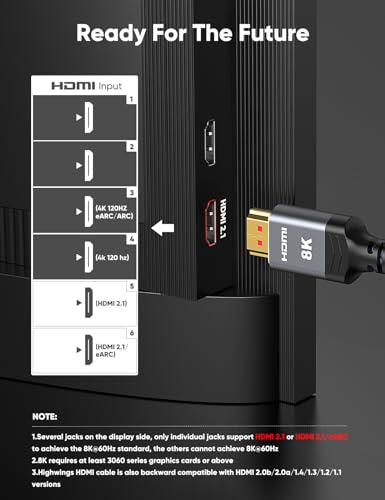
- Confirm both source and sink hardware support the targeted mode (e.g., 4K@120Hz requires both to be compliant)
- Check TV/monitor input settings and disable any compatibility/low-bandwidth modes
- Try a different HDMI port on the display; some sets only enable full bandwidth on specific inputs
- Re-seat the connectors and use a short, firm push — poor contact will reduce bandwidth negotiation
Practical technical summary
You get a pair of cables designed for present and near-future AV demands: robust shielding, proven connector mechanics, and a cable geometry optimized for high-frequency digital signaling. The build trades a little flexibility for long-term resilience and EMI resistance, which is a sensible compromise if you’re running premium consoles, UHD players, or routing signals through a home theater stack.
- Ideal for 6.6-foot desktop or living-room runs
- Built with longevity and EMI control in mind
- Two-cable pack increases flexibility for multi-device setups
Final take — who should pick these up
Choose this two-pack if you want to deploy HDMI 2.1 features with confidence across two devices without spending on boutique cables. It’s especially useful when you need a rugged cable that will survive repeated hookups, swaps, and the occasional accidental tug while still delivering the high-bandwidth signaling required for 4K@120Hz and 8K@60Hz scenarios.
FAQ
Will this cable let my PS5 run 4K at 120Hz and HDR at the same time?
Yes — provided your TV supports 4K@120Hz over an HDMI 2.1 input and has HDR enabled. The cable carries the full bandwidth and metadata, but the final display mode depends on the TV/monitor’s input capabilities and firmware settings.
If my TV only has HDMI 2.0 ports, will I still see improvement?
You’ll still get a high-quality connection, but HDMI 2.0 limits will cap resolution/refresh (typically 4K@60Hz). The cable won’t force higher modes on an older TV — it simply ensures the link won’t be the limiting factor if you later upgrade the display.
How do I tell if the cable is actually negotiating 48 Gbps?
Most displays disclose the negotiated input mode in their info menus. Look for reported bandwidth, color depth, or the active resolution/refresh. If you see 4K@120Hz or 8K@60Hz with HDR enabled, the link is operating at full capability.
Is this cable good for routing through walls or in-ceiling runs?
For short in-wall or in-ceiling runs it can work, but code and safety typically require in-wall-rated cables. Also consider that long passive HDMI runs can degrade; for runs longer than ~10 meters (33 ft), active or optical HDMI solutions are recommended.
Why can’t I bend the cable sharply behind my TV?
Sharp bends increase conductor stress and can change the signal impedance, which may cause link drops or reduced negotiated modes. Use gentle radii and secure the cable with clips rather than tight wraps to preserve signal integrity.
Will eARC work through this cable with my soundbar and TV?
Yes — the cable supports eARC so you can pass high-bitrate, object-based audio formats from the TV to your soundbar or AV receiver, as long as the TV, soundbar/receiver, and any intermediary splitters or switches also support eARC.
Author

Like this deal? Get deals like this every week.

