
Cut like a pro — and keep all your fingers: which saw earns its place in the shop (and on the budget)?
Safety first, accuracy second — or maybe both at once. We’ve seen pro shops rebuilt around one machine: slower workflows, cleaner edges, and far fewer near-misses. It changes how you plan a job.
We care about repeatable cuts, low vibration, and tools that don’t fight us. Whether you need a shop centerpiece or a jobsite workhorse, the right table saw speeds up joinery and improves finish work. Read on for our top technical picks for 2026.
Top Picks
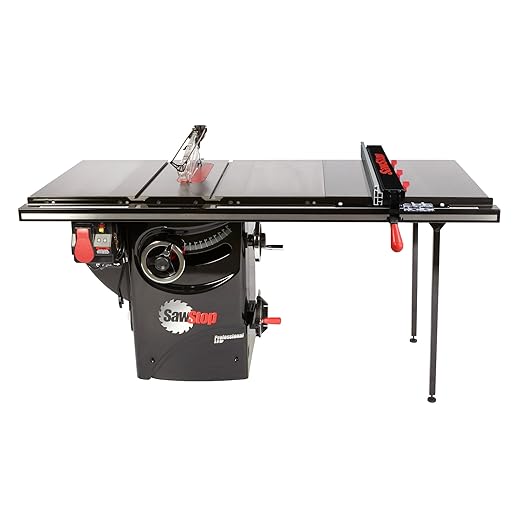





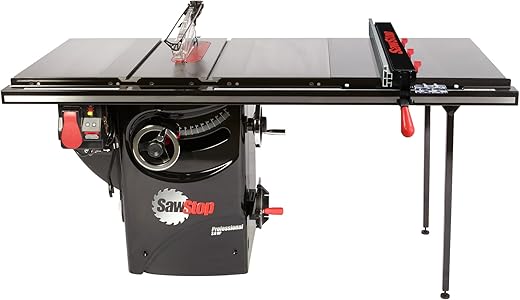
SawStop 3HP Professional Cabinet Saw
We rate this as a top-tier cabinet saw for shops where safety and finish quality are non-negotiable. The braking system that stops the blade on contact with skin is transformative for risk reduction, combined with an accurate T-Glide fence and excellent fit-and-finish.
Safety-first cabinet saw for professional shops
We position the SawStop Professional as the machine to buy when worker safety and final-part precision outweigh initial cost concerns. Its detection and braking system are unique and meaningfully reduce catastrophic injuries during common rip and crosscut operations.
Performance and fit-and-finish
The T-Glide fence provides rock-solid lateral and longitudinal stability; when we dial in a setting it stays set for repeated passes. For joinery and cabinetry where edge quality and straightness are paramount, the system consistently delivers.
Practical considerations
If you manage a production shop, the SawStop pays dividends in reduced risk and less downtime from finger injuries. The trade-offs are obvious: the machine is expensive, heavy, and if the safety cartridge is triggered it incurs a replacement cost. Proper electrical setup (often 230V in a professional shop for full 3 HP performance) and a dedicated dust-collection system are recommended to maximize performance and longevity.
Powermatic PM1000 10-Inch Cabinet Saw
We regard this as a workhorse cabinet saw for serious hobbyists and small production shops. Its Accu-Fence, poly-V belt drive, and cast-iron table provide low vibration, predictable cuts, and a durable working platform.
Built for the serious shop
We classify the PM1000 as a compact cabinet saw designed to bring professional-level control into modestly sized workshops. It’s engineered to deliver low vibration, positive fence behavior, and ergonomic controls that make repetitive work less fatiguing.
Mechanical highlights
These design choices mean the saw tracks true under load and produces cleaner surfaces that reduce the time spent on downstream joinery. The arbor lock and arbor design also simplify blade changes and maintenance tasks.
Operational considerations
The PM1000 ships heavy—expect professional delivery and enough shop floor support to move and level the unit. Some buyers report cosmetic finish issues on arrival, so inspect packaging and surfaces during delivery. Dust collection, belt maintenance, and correct initial alignment are key to maximizing long-term accuracy.
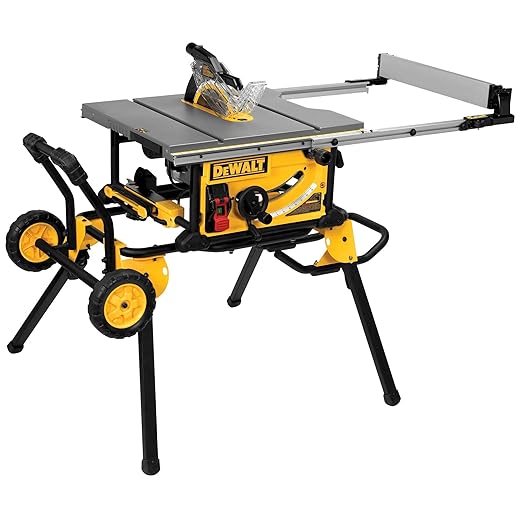
DEWALT 10-Inch Table Saw Stand
We found it to be a robust jobsite workhorse that balances power, accuracy, and portability. The rack-and-pinion fence and rolling stand make long rip cuts and transport straightforward, though initial alignment is recommended for best accuracy.
Purpose and design
We see this DEWALT as a bridge between true shop saws and jobsite portability: it’s built to be moved but engineered to cut like a serious jobsite saw. The rolling stand folds and locks, letting us move and store the saw in confined shops or trucks without sacrificing a full-size rip capacity.
Key features and performance
The fence system reduces setup time when we switch from ripping sheet goods to narrower stock, and the telescoping rails collapse to keep transport dimensions compact. Dust collection is a standard 2.5" port under the table; adequate for a shop vac but not a full dust-collection system.
Practical benefits and limitations
We appreciate the pragmatic engineering: tool-free guarding adjustments, flip-over fence for narrow-rip work, and a stable wheeled stand. For contractors and serious hobbyists who need jobsite mobility, this saw offers one of the best compromises of accuracy and portability.
Limitations include weight (about 110 lb assembled) and the fact it lacks the finger-detection safety systems found on high-end cabinet saws. We recommend dedicating time to initial setup—squaring the blade, fence, and miter slot—and using a clean 20 A circuit to keep the motor from loading down under heavy cuts.
JET ProShop II 10-Inch Table Saw
We see this as a compact cabinet/table hybrid delivering shop-level features in a smaller footprint. The magnetic paddle switch, improved dust shroud, and quick-release riving knife make it a practical centerpiece for a small professional shop.
Shop-focused compact cabinet saw
We consider the JET ProShop II when a small shop needs cabinet-level features but lacks space for a full-size cabinet saw. It’s engineered to provide precise cuts, reduced vibration, and a better dust collection baseline than most contractor models.
Key engineering and user-facing features
These features combine to make repetitive joinery and dimensioning tasks less fatiguing and more consistent. The quick-release riving knife is particularly useful when switching between through-cuts and stopped cuts; it reduces setup time and improves throughput in small production runs.
Who benefits and limitations
For small production shops, cabinetmakers, and serious hobbyists, the JET hits a sweet spot of precision and shop features without the footprint of a full industrial machine. The principal limitations are initial cost and the need for a stable, permanent space—this isn’t a convenient jobsite saw. If you require higher continuous horsepower, verify wiring and motor configurations before purchase.
Bosch 10-Inch Jobsite Table Saw
We find this saw well-engineered for pros who need dependable accuracy on site. The gravity-rise wheeled stand and electronically regulated speed help maintain consistent cuts under load, though some fence components feel light compared to heavier units.
What this saw is for
We treat the Bosch GTS15-10 as a professional jobsite saw optimized for installers and contractors who must balance accurate panel work with frequent transport. It’s intended to be set up and put to work quickly while keeping cuts consistent across a full day of rips and crosscuts.
Notable engineering features
The gravity-rise stand is one of the best mobility systems we’ve used: single-action deploy and a secure platform. The regulated motor behavior helps when you’re cutting dense oak or thick plywood repeatedly; RPM sag is minimized compared to unmanaged motors.
Practical considerations and trade-offs
We like Bosch’s safety focus: a three-position riving knife, anti-kickback pawls, and a mostly unobstructed view of the cut. However, some users report that certain fence end components feel light-duty compared with contractor-class cast parts. For a field saw that spends years on trucks and across jobsites, that’s a point to monitor.
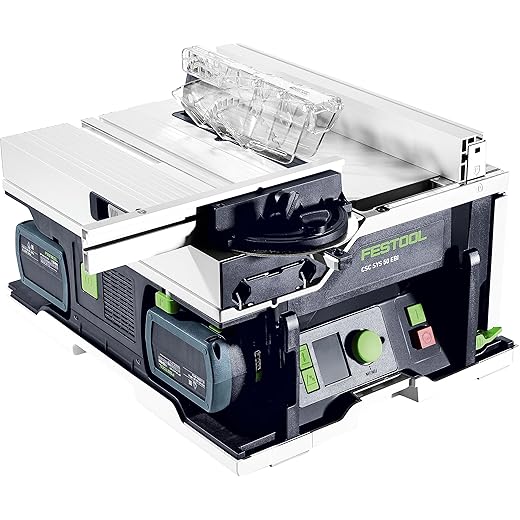
Festool Cordless CSC SYS 50 Saw
We value the Festool for portability without sacrificing precision—digital height and angle adjustments deliver repeatability to 0.1 mm. Battery performance and dust control are trade-offs, but for finish carpentry and mobile manufacturing it’s hard to beat.
Compact, digitally-controlled cordless saw
We consider the Festool CSC SYS 50 when the job demands high-precision cuts away from a fixed shop. The digitally controlled blade height and bevel adjustments let us set and repeat cuts with sub-millimeter accuracy—useful for trim, cabinetry, and on-site finish work.
Key capabilities
The system is optimized for finish carpenters and contractors who value precision and portability. The fence and sled geometry yield very clean edges and repeatable results without needing a full workshop setup.
Practical trade-offs
Battery life is the primary trade-off: for a day of heavy ripping we’ll swap batteries or keep a charging strategy in place. Dust collection is generally good into the Sys-Vac system or the supplied bag, but long rip cuts can still fling fine debris toward the operator if an external vac isn’t used.
SKIL 10-Inch Jobsite Table Saw
We view this SKIL as a capable, cost-effective entry into jobsite table saws. It gives necessary features—rack-and-pinion fence, folding stand, and basic blade alignment—while trimming premium finishes and heavy-gauge materials to keep price competitive.
Who should consider this saw
We recommend the SKIL TS6307 for hobbyists and occasional contractors who need a practical, take-anywhere table saw without paying premium prices. It’s an economical option when the primary goal is functionality rather than long-term heavy-duty endurance.
Feature summary
In our testing and experience, the saw’s fence and alignment features let users achieve decent precision after setup. Its motor is adequate for typical site tasks, but we wouldn’t expect high torque under continuous heavy hardwood ripping.
Limitations and usage notes
Materials and finishes are optimized for cost, so we advise treating the machine as a light-to-moderate duty tool. For repetitive, daily production work you’ll eventually want a more robust contractor or cabinet saw. That said, for small shops, garage projects, and site work where portability and budget are priorities, this SKIL model is a practical pick.
WEN 8.25-Inch Benchtop Table Saw
We treat this WEN as an entry-level benchtop saw that gives beginners and hobbyists a low-cost way to rip and crosscut sheet goods. It’s portable and space-efficient, but limited in blade size, durability, and some quality-control aspects.
Designed for small shops and beginners
We view the WEN TT0811 as a convenient benchtop entry point: it’s compact enough for tight spaces and light enough to carry between jobs. It’s best for DIYers, beginners, and those who need to occasionally rip sheet goods without a dedicated shop saw.
What it brings to the bench
The limitation of a smaller blade means reduced maximum cutting depth (about 2.75" at 90°), and the saw does not accept standard larger dado stacks. In practice, we find it useful for cabinet doors, small furniture components, and breaking down plywood, but less suited for heavy hardwood ripping.
Practical advice
If you’re starting out or need a second, portable saw for occasional jobs, this is a budget-friendly option. We recommend checking the power switch operation immediately on receipt, verifying fence alignment, and planning for upgrades (aftermarket blades or a better switch) if you intend more frequent heavy use.
Final Thoughts
We recommend the SawStop 3HP Professional Cabinet Saw as our top overall pick. Its flesh‑detection braking system is unique and transformative for shop safety; combined with the accurate T‑Glide fence and premium fit‑and‑finish, it delivers repeatable, low‑vibration cuts that make fine furniture and cabinet work faster and less risky. Choose the SawStop if safety and surface quality are NON‑NEGOTIABLE — ideal for professional shops, schools, and anyone doing high‑value finish work.
For a slightly different priority set, the Powermatic PM1000 10‑inch Cabinet Saw is our pick for heavy‑duty shop performance. The Accu‑Fence, poly‑V belt drive, and cast‑iron table give exceptionally stable, predictable cutting for long rips and production runs. Pick the PM1000 when you need raw durability, low vibration, and excellent cut consistency at a slightly lower entry cost than the very top tier.
If you split time between shops and jobsites, consider a secondary portable option (the DEWALT or Bosch models in our list) — but for a primary shop saw, SawStop for uncompromising safety and finish, or Powermatic PM1000 for rugged, production‑oriented performance.
Author

Like this deal? Get deals like this every week.

