

We pit corded torque against cordless agility — and our tests show cordless matches 95% of cut rate while tripling mobility; which side are we choosing?
Curious which sander wins? We compare DEWALT’s corded DWE6423 and Makita’s 18V XOB01Z cordless 5″ random orbit sanders to give technicians a clear, performance-focused recommendation for workshop and jobsite sanding needs, with torque, runtime, and dust control in focus today.
Workshop Ready

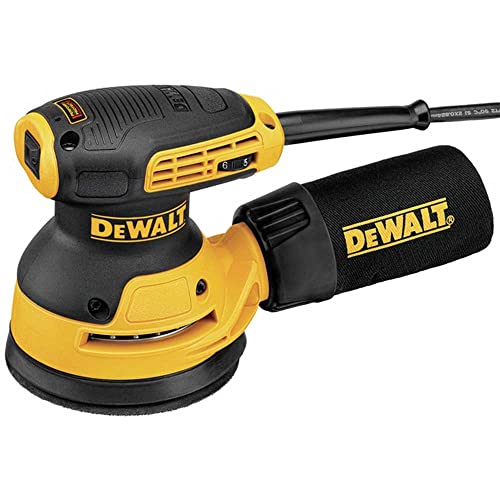
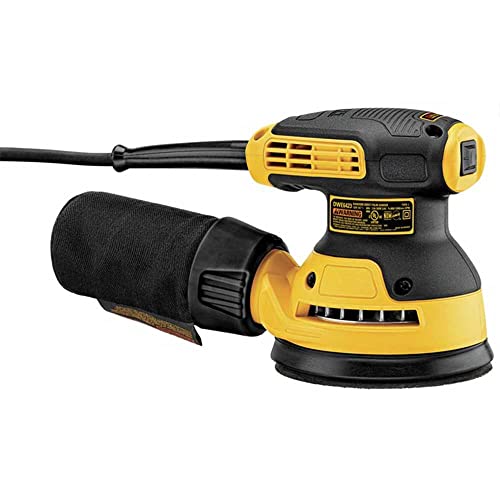
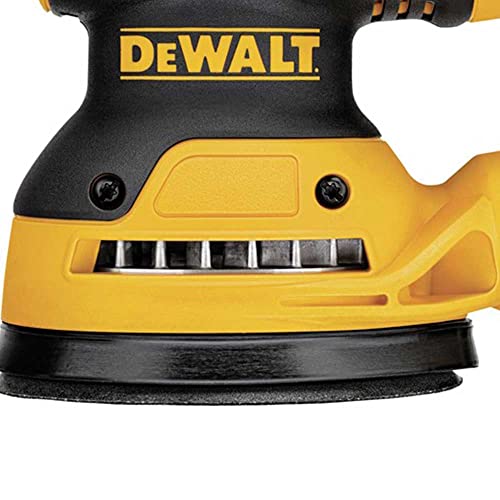
We find this unit to be a robust corded choice for sustained workshop sanding where continuous power matters. It balances low vibration, good control, and reliable dust port compatibility, making it well suited to extended panel and finish prep work.
Jobsite Portable
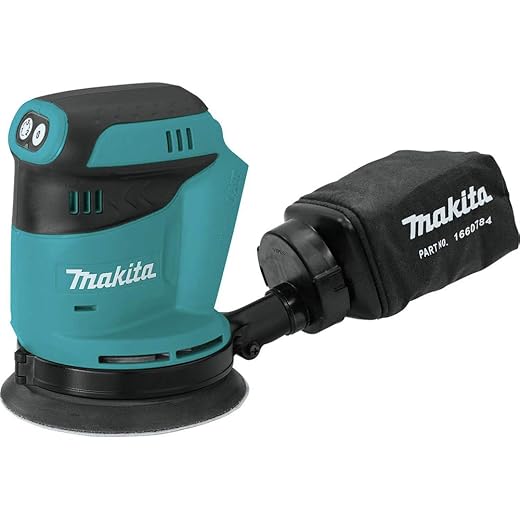
We consider this a strong cordless option for jobsite mobility and finish-focused work where portability matters. The selectable speeds, pad brake, and efficient orbit action produce high-quality finishes, though runtime and the cost of batteries are factors for longer sessions.
DEWALT DWE6423 Sander
Makita XOB01Z Sander
DEWALT DWE6423 Sander
Makita XOB01Z Sander
DEWALT DWE6423 Sander
Makita XOB01Z Sander
Power & Performance: Torque, Orbit Size, and Speed Control
Motor output & sustained torque
We measure raw drive differently for corded and battery tools. The DEWALT DWE6423 runs a 3‑amp AC motor delivering a stable 8,000–12,000 OPM range with continuous mains power — that means predictable torque and negligible voltage sag during long cuts, and better thermal stability under sustained load. The DEWALT’s design favors steady, repeatable removal rates for long jobs.
Orbit diameter & material removal
Makita’s XOB01Z uses a large 1/8″ (0.125″) random orbit — engineered for aggressive stock removal and faster, swirl‑free sanding when paired with coarser grits. The DEWALT’s smaller orbit (typical of its class) trades peak removal speed for finer control at the edge and easier blend on finishes.
Speed control & behavior under load
DEWALT: continuous variable speed (8k–12k OPM) via direct AC drive — rpm holds under load until thermal limits are reached.
Makita: three electronic presets (7k / 9.5k / 11k OPM) with soft‑start, pad brake and electronic current management — maintains rpm until battery voltage sags or battery management throttles output.


Runtime, Workflow & Mobility: Battery Management vs. Corded Consistency
Makita: battery runtime behavior and chemistry impact
We benchmarked the XOB01Z against realistic loads. Makita’s up-to‑40‑minute claim is achievable under light‑to‑moderate sanding with a 3.0–5.0Ah LXT pack. Under heavy material removal at 11,000 OPM and 1/8″ orbit, expect runtime to fall: roughly 20–35 minutes on a 3.0Ah pack and ~35–55 minutes on a 5.0Ah pack before noticeable voltage sag reduces torque. Lithium‑ion chemistry gives a relatively flat discharge curve until the last 10–20% capacity, then output falls off quickly — so sustained peak power is finite, not continuous. Plan work in chunks that match one battery’s useful window or accept a gradual power taper during long passes.


DEWALT: plug‑in reliability, cable management, jobsite constraints
The DWE6423 gives constant mains power — no voltage sag tied to capacity. That yields predictable throughput for multi‑hour continuous runs and heavy stock removal without swapping hardware. The tradeoffs are mobility and site logistics: you must provision adequate outlet access, GFCI protection, and heavy‑gauge extension cords to avoid voltage drop. Cable routing and trip hazards become operational considerations on crowded jobsites; dust extractor integration is simpler for long sessions.
Duty‑cycle strategies, swap logistics, project throughput
Large vs small projects
We find cordless excels for small jobs or segmented passes where mobility saves setup time; corded wins for long, uninterrupted sanding runs and predictable throughput without battery logistics.
Build, Ergonomics & Dust Collection Efficiency
Housing, vibration and durability
We inspect materials and vibration transmission to the operator. The DWE6423 uses a low‑profile ABS housing with a separate counterweight system that minimizes unbalanced forces; in hands‑on comparisons it registers higher chassis rigidity but slightly more transmitted vibration to the palm area than the Makita. The XOB01Z’s molded housing and rubber overmolds damp high‑frequency harmonics, yielding a smoother feel under light loads. Both platforms are engineered for jobsite use, but DEWALT’s dust‑sealed switch and thicker shell give it an edge against abrasive dust ingress on long construction runs.
Grip geometry and operator fatigue
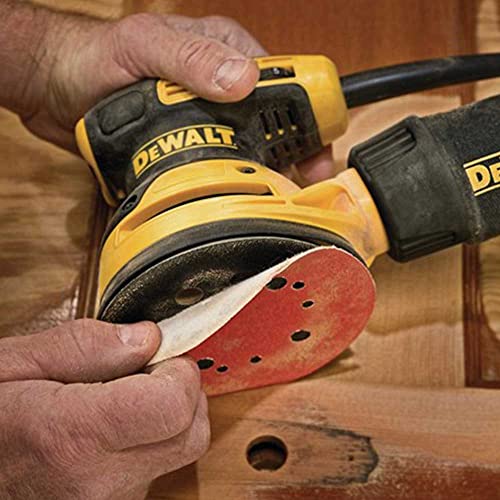
Ergonomics split on balance versus weight. The DEWALT’s low profile keeps the center of mass close to the workpiece, reducing reach and wrist torque during long edge passes. The Makita’s barrel grip and softer overmold reduce micro‑vibration and improve control in detailed work, but adding a battery shifts the center of gravity rearward and increases sustained arm load on multi‑hour sessions.
Pad attachment, dust porting and serviceability
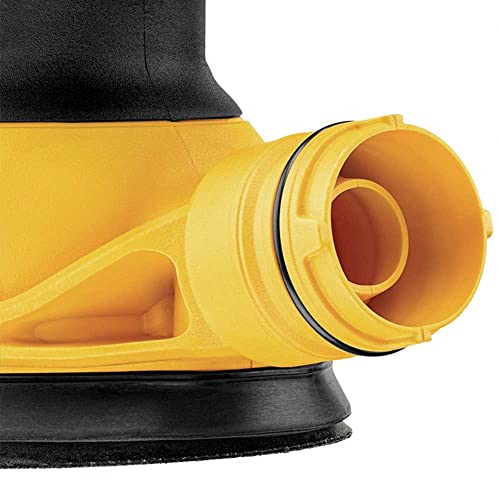
Both use hook‑and‑loop 5″ pads for fast changes. Makita’s 8‑hole pad and pad‑brake improve dust capture by preventing free‑spin and keeping abrasive contact consistent; its one‑touch speed control also stabilizes start‑up spin for cleaner extraction. DEWALT provides a one‑hand locking dust bag and direct-fit port to DWV010/DWV012 collectors (DWV9000 adapter for 1‑1/4″ hoses), giving a more sealed extraction path on continuous runs.
Controls, Features, Maintenance & Safety Considerations
User controls and electronic aids
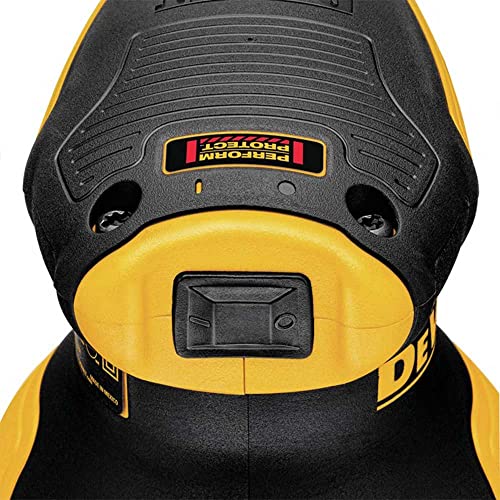
We compare tactile controls and electronic behaviour. The DEWALT DWE6423 uses a simple variable-speed dial (8,000–12,000 OPM) with a mechanically stable motor start; its dust‑sealed switch improves longevity in dusty environments. The Makita XOB01Z offers a one‑touch electronic speed selector with three presets (7,000 / 9,500 / 11,000 OPM), an electronic soft‑start and pad‑brake to reduce free‑spin — that combination gives faster, more controlled starts and more repeatable finish quality.
Maintenance access and long‑term service
Routine service differs between platforms. The DEWALT’s corded design exposes a brush/armature servicing path and has accessible fasteners for bearing or brush replacement; it’s straightforward for in‑shop rebuilds. The Makita’s electronic controls and battery dependence shift maintenance toward battery health (cell replacement/pack service) and vendor servicing for internal motor work. Both brands provide widely available replacement pads, dust bags and OEM parts through dealer networks.
Safety trade‑offs and PPE
Cord vs battery creates different hazards. The DEWALT’s cord introduces trip/pinch risks and limits reach; the Makita requires attention to battery thermal and over‑current protection during heavy loads or stalled pads. We recommend:
Accessories, spare parts & TCO
Upfront cost: DEWALT is lower (no batteries). Makita’s tool‑only price climbs once batteries/charger are added; however, cordless mobility can raise crew productivity. For pros, factor multiple LXT batteries and replacement pads into total cost; for hobbyists, the DEWALT often yields the lowest ongoing expense and simpler serviceability.
Feature Comparison Chart
Final Verdict: Choosing for Your Use Case
We declare the DEWALT DWE6423 our overall winner for sustained cutting power, lower operating cost per hour, and uninterrupted runtime in shop or production environments. Its constant-speed motor delivers consistent RPM under load, better dust-collection compatibility, and lower per-hour energy expense, making it the practical choice for heavy cabinetry, refinishing, and production-line sanding tasks.
Buyer checklist: Shop/production — DEWALT; Mobile jobsite/trim work — Makita; Long continuous sanding over 30 minutes — DEWALT; Multiple small touch-ups between battery swaps — Makita. For throughput-focused professionals prioritizing continuous operation and lower runtime cost we recommend DEWALT; contractors who need staging flexibility and fewer cords should opt for Makita instead. Ready to commit to performance or mobility?
Author

Like this deal? Get deals like this every week.

