

We put DEWALT’s 20V impact driver and drill driver head‑to‑head — which tool delivers jaw‑dropping torque for lugging lag bolts, surgical precision for pilot holes, and truly doubles our workflow on the jobsite?
We face daily trades decisions: speed versus control, compact punches versus versatile drilling. We pit the DEWALT 20V DCF845B impact driver against the DCD771C2 drill-driver—same battery platform, different motor, torque delivery, and kit contents—so you pick the right 20V workhorse.
High Torque
We find this unit excels as a purpose-built fastening tool: its brushless motor and 3-speed selector deliver excellent control and high torque in a compact chassis. For users focused on driving and high-torque fastening tasks this balances power, runtime efficiency, and ergonomics very well.
Compact Versatility
We regard this drill/driver kit as a well-balanced general-purpose toolset for DIY and light-construction tasks: compact, reliable and ready-to-use out of the box. It provides good control and adequate power for most household and light contractor applications but is not a substitute for a dedicated high-torque impact when driving large fasteners.
DEWALT DCF845B Driver
DEWALT DCD771C2 Drill
DEWALT DCF845B Driver
DEWALT DCD771C2 Drill
DEWALT DCF845B Driver
DEWALT DCD771C2 Drill
Detailed Hardware & Specs Breakdown
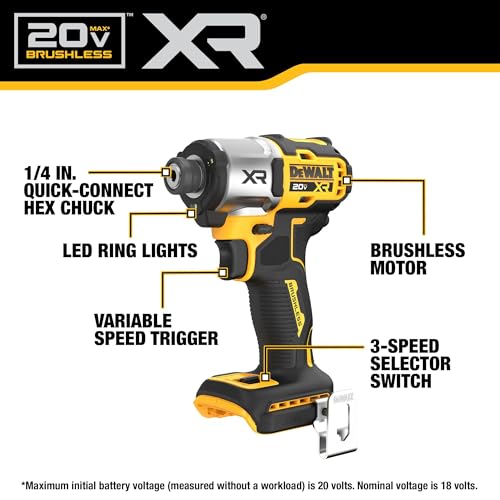
DCF845B — 20V MAX XR Impact Driver (brushless)
We break down the impact driver as a dedicated high-torque fastening tool: brushless high‑efficiency motor, 1/4″ hex quick‑change bit holder, and a 3‑speed selector for control and start-up finesse.
DCD771C2 — 20V Max Compact Drill/Driver (brushed)
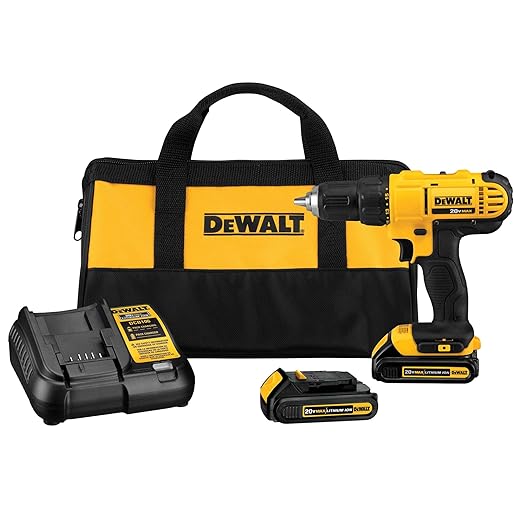
We treat the DCD771C2 as the generalist: brushed high‑performance motor, two‑speed gearbox, and a single‑sleeve ratcheting chuck for round‑shank bits. Note: marketing states a 1/2″ chuck, but some kit specs list 3/8″ — verify your SKU if maximum chuck capacity matters.


Feature Comparison Chart

Real-World Performance: Torque, Speed, and Applications
Impact driver — shear vs. impulse torque, IPM/RPM behavior, bit retention, fine control
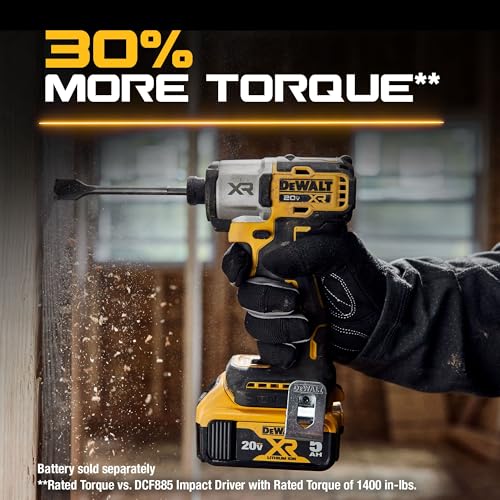
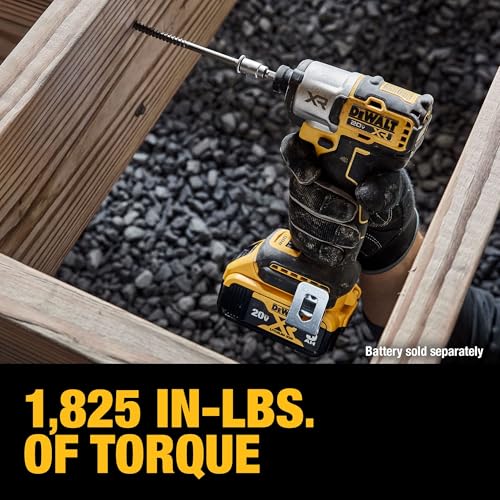
We see the DCF845B as a concussive torque tool: the brushless motor produces 1,825 in‑lbs of peak torque delivered in short, high‑force impulses. That impulse pattern (high IPM bursts at up to 3,400 RPM nominal) rips large screws quickly with minimal stalling. The 1/4″ hex quick‑change holds bits solidly under shock loads, and the 3‑speed selector plus variable trigger give surprising start‑up finesse for delicate starts — but the impact’s stepped blows can still overdrive very fine trim screws if we’re not careful.

Drill driver — hole speed, wobble, clutch torque limiting, material suitability
The DCD771C2 runs 0–450 / 0–1,500 RPM, producing steady, sustained RPM for clean hole cutting. Its mechanical clutch lets us meter torque and avoid cam‑out during final turns, giving controlled thread starts and repeatable screw seating. The keyed/ratcheting chuck (single‑sleeve) reduces bit wobble for longer bits and drill bits, so holes in wood and metal stay round and centered. Torque is lower (~530–650 in‑lbs), so the drill struggles with large lags or long structural deck screws compared with the impact.


Battery, Runtime, Charging and Power Management
Battery ecosystem & compatibility
We note the DCF845B is sold as a bare XR tool; it pairs with DEWALT 20V MAX XR packs (2.0–9.0Ah commonly). The DCD771C2 ships with two 1.3Ah XR cells and a standard charger. All DEWALT 20V MAX batteries are cross‑compatible with both tools.
Runtime math & real expectations
Brushless motors in the DCF845B run more efficiently than brushed designs, typically reducing average amp draw for the same output by ~10–25% and cutting heat under load. Use this simple approximation: runtime (minutes) ≈ (Ah × 60) / average current (A). Typical average currents under load:
Example: a 1.3Ah pack at a 10 A average draw ≈ (1.3×60)/10 ≈ 7.8 minutes continuous; in real intermittent use this multiplies several-fold (start/stop work duty cycle). Impact drivers deliver bursts, so real fastener counts per Ah are higher than continuous-drill minutes.
Charging & heat management
The kit’s standard charger will top a 1.3Ah pack in roughly 30–45 minutes; larger XR packs (4–5Ah) typically take 60–90+ minutes on the basic charger. Using DEWALT fast chargers reduces those times. Avoid charging hot batteries; let packs cool after heavy work to reduce thermal stress and extend cycle life.
Practical sizing tips
Quick recommendations:
Ergonomics, Durability, Accessories, and Value
Grip, balance, and LED placement
We find the DCF845B (2.2 lb) noticeably more compact and front‑centered in mass: its short body and inline center of gravity reduce wrist torque for overhead and repetitive fastening. The integrated 3‑LED array sits close to the bit for shadow‑free illumination. The DCD771C2 is heavier (~3.6 lb with battery), with more forward mass from the 1/2″ chuck and battery; its single LED aids alignment but is less bright and more rear‑biased.
Durability & mechanical interfaces
The impact’s metal 1/4″ quick‑change anvil and brushless motor are built for high‑torque cycles and shock loading. The drill’s 1/2″ single‑sleeve ratcheting chuck grips bits well for drilling but isn’t rated for impact‑level fastening. Both use rugged DEWALT housings; we expect the impact to outlast the drill under heavy fastening duty.
Included accessories
Cost-per-function, warranty & ROI
Final Verdict: Which DEWALT 20V Tool Should We Choose?
We choose the DCF845B impact driver as winner for high-torque driving, speed, and compactness — best for framing, decking and repetitive fastening when paired with XR batteries. Its brushless motor and 3-speed control make it our go-to for heavy fastening workflows.
We still recommend the DCD771C2 drill-driver kit as the smartest starter purchase: two batteries, charger and a versatile 2‑speed drill for general drilling and light fastening. Which workflow will you prioritize?


