

Battery that outlasts your excuses or maps that actually get you home — which side are you on?
You don’t need to spend $300 to get GPS, maps, and a week of battery. Budget trackers and entry smartwatches have matured: big AMOLEDs, reliable sensors, and decent GPS are now realistic on a shoestring.
This list slices through specs so you don’t have to. You’ll see which devices focus on battery and display versus navigation and sport features, so you can pick the right tool for your routine in seconds.
Top Picks
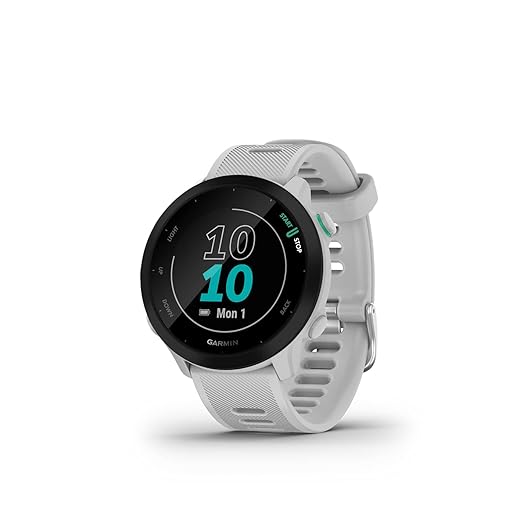


Garmin Forerunner 55 — Running-Focused GPS Watch
You’ll get proven training tools, strong GPS performance, and a long battery life tailored to runners and fitness enthusiasts. The Forerunner 55 focuses on delivering actionable training guidance and easy‑to‑use metrics without unnecessary complexity.
Pros
- Accurate GPS and heart‑rate tracking with race‑focused features
- Useful training aids: Daily Suggested Workouts and PacePro guidance
- Up to 2 weeks battery life in smartwatch mode
- Lightweight, durable design with expandable app/face ecosystem
- Strong wellness features: respiration, fitness age, tracking profiles
Cons
- More limited smartwatch app ecosystem vs flagship Garmin models
- No onboard music storage or NFC payments
- Basic screen compared with high‑end AMOLED watches
Overview
The Forerunner 55 is designed with runners in mind: simple controls, reliable GPS, and training guidance that helps you plan workouts, predict race times, and track recovery. Garmin’s race‑and‑run centric feature set is exposed in a straightforward UI that you can use while focused on performance.
Training features that matter
- Daily Suggested Workouts that adapt to your training history and recovery
- PacePro pacing strategies for race planning and on‑course guidance
- Built‑in activity profiles for running, cycling, pool swim, HIIT, and more
These features translate to practical coaching on your wrist: if you want a recommended run based on recent load and recovery, the Forerunner 55 will propose session intensity and duration. PacePro helps you execute an even or negative‑split race strategy without spreadsheets.
Real‑world strengths and limitations
Battery life and GPS fidelity are the standout strengths — you can expect multi‑day smartwatch runtimes and reliable route logging during long runs. The trade‑offs are fewer lifestyle features: there’s no onboard music storage or contactless payments, and the display is functional rather than flashy. For focused runners who prioritize training data over smartwatch glitz, that’s a reasonable compromise.
Who should buy it
Pick the Forerunner 55 if you’re training for 5K to half‑marathon distances and want a dependable, affordable GPS watch that offers suggested workouts, pacing tools, and solid battery life without unnecessary extras.
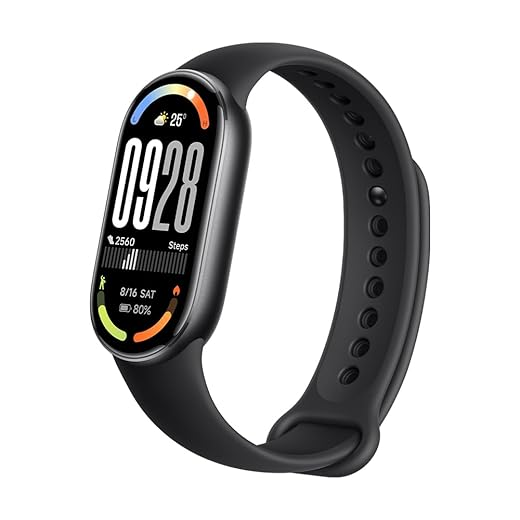
Xiaomi Mi Smart Band 10 — Giant Display
You’ll get one of the brightest, largest AMOLED screens on a budget band and industry‑leading battery life. It’s a strong hardware step forward; software edge cases remain the main area for improvement.
Pros
- Huge 1.72" AMOLED display with 1500 nits HBM for sunlight legibility
- Exceptional ~21‑day battery life and fast recharge
- Robust multi‑sport tracking and improved sensor accuracy
- HyperOS responsiveness and BT5.4 connectivity
- Affordable price with a mature fitness feature set
Cons
- Xiaomi Fit app defaults to metric system; imperial setup requires extra steps
- Notification management can be finicky on some phones
- Stock silicone band feels low cost compared with the hardware
Overview
The Mi Smart Band 10 raises the bar for what you can expect from a budget fitness band: a very large 1.72" AMOLED display, long battery runtime, and significantly improved sensors. If display clarity and battery runtime are your primary needs, the Band 10 delivers strong value.
Notable hardware and battery behavior
- 1.72" AMOLED with ultra‑thin bezels and vacuum filling sealing for improved screen‑to‑body ratio
- 1500 nits peak brightness for usable outdoors visibility
- Up to 21 days battery life and fast one‑hour charging when you do need power
In practice that means you can use Always‑On modes selectively and still get multi‑week runtimes. For example, if you enable auto‑brightness and disable some constant sensors, a two‑week to three‑week cadence is realistic.
Software trade‑offs and real‑world usage
Xiaomi’s HyperOS delivers a smooth UI experience on the band itself, but the Mi Fit app remains the weak link: metric defaults and intermittent notification quirks are common. You can work around the imperial limitation by syncing with Google Fit, but that’s an extra configuration step. For everyday fitness you’ll appreciate the reliable step counting, pulse monitoring, and sleep analysis, though advanced athletes may want a watch with more granular workout metrics.
Who this fits
Choose this band if you prioritize screen real‑estate and battery for a low cost. It’s ideal for users who want a comfortable, long‑lasting wearable to monitor sleep, daily activity, and regular workouts without the overhead of a full smartwatch.
Amazfit Bip 6 — GPS-Ready 1.97" Smartwatch
You get built‑in GPS, downloadable maps, and a large 1.97" AMOLED at a price that undercuts many incumbents. It’s a strong choice if you want navigation and sport‑focused features in an affordable package.
Pros
- Built‑in GPS with free maps and turn‑by‑turn directions
- Large 1.97" AMOLED display for rich data visualization
- 140+ workout modes and AI coaching features
- Up to two weeks of battery life in typical scenarios
- Bluetooth calling and robust notification handling
Cons
- Battery life can vary significantly with heavy GPS/AOD use
- Bundled plastic strap feels cheap but is replaceable
- Some users report occasional connectivity quirks with music control
Overview
The Bip 6 positions itself as an everyday smartwatch with genuine navigation capabilities. With an oversized AMOLED, multi‑day battery, and support for downloadable route maps, it narrows the gap between budget trackers and more expensive GPS watches.
GPS, mapping, and training features
- Built‑in multi‑satellite GPS and support for free downloadable maps
- 140+ workout modes and AI‑driven coaching to guide sessions
- Real‑time health monitoring: heart rate, SpO2, sleep, and stress metrics
Those capabilities let you head out for runs or rides without your phone and still get post‑workout maps and metrics. For example, you can download a route, follow turn‑by‑turn guidance, and review detailed traces on the companion app later.
Real‑world strengths and limits
In everyday use the Bip 6 is dependable: notifications are timely, the display is bright, and health metrics are in the expected accuracy band for PPG sensors. Battery life is competitive, but expect significant drops if you use built‑in GPS extensively or enable Always‑On Display. The default strap is functional but swapping to a higher‑quality 22mm band improves comfort and longevity.
Who should pick this
If you want a competent GPS watch without paying flagship prices and you value mapping and navigation on the wrist, this is a compelling option. If you need maximal battery when using GPS heavily or a premium strap out of the box, budget for a third‑party band or a higher‑end multisport watch.
Amazfit Band 7 — Large AMOLED Band
You get a large, bright AMOLED display and very long battery life in a compact, affordable form factor. The Band 7 is a pragmatic choice when you want reliable health metrics and basic smart features without the complexity or frequent charging of a watch.
Pros
- Impressive 1.47" AMOLED display that’s easily readable
- Up to ~18 days battery life in typical use
- Comprehensive health tracking: HR, SpO2, sleep stages
- 120+ sports modes and 5 ATM water resistance
- Built-in Amazon Alexa and lightweight Zepp OS
Cons
- Band/strap retention can be unreliable for some users
- Occasional sensor inaccuracies and UI sensitivity
- Limited third‑party app ecosystem compared with full smartwatches
Overview
The Band 7 targets you if you want a capable fitness tracker with a large, high‑contrast screen and multi‑day battery life. It focuses on core health metrics (heart rate, SpO2, sleep stages, stress and menstrual tracking) and packs dozens of sports modes while keeping the device size minimal and the price low.
Key features and what they mean for you
- 1.47" Always-On AMOLED display with high pixel density for clear metrics and notifications
- Up to 18 days of battery life (typical use) so you can track sleep and workouts without nightly charging
- Built‑in Amazon Alexa for quick voice queries and shortcuts
- 120+ sports modes and 5 ATM water resistance for swim tracking
These specs make the device useful if you prioritize glanceable data and long runtime. For example, you can leave it on overnight to record uninterrupted sleep metrics and still have several days of battery left for daytime workouts.
Practical strengths and limitations
The Band 7 is strong as a low‑cost daily tracker: the display is noticeably larger than older bands and Zepp OS keeps interactions snappy. You should be aware of a few real‑world caveats: some users report the wrist band latch can loosen, and the optical sensors can show occasional outliers during sudden heart rate changes. In short, it’s excellent for activity trends and general health awareness but not a medical‑grade monitor.
Who should buy it
If you want a budget tracker that reads clearly outdoors, lasts weeks between charges, and covers the essentials (HR, SpO2, sleep), this is a sensible purchase. If you need precise ECG‑level accuracy, phone‑app integrations with advanced third‑party tools, or a more robust strap system out of the box, consider stepping up to a larger smartwatch platform.
Fitbit Inspire 2 — Slim Wellness Tracker
You’ll appreciate its slim profile, reliable heart‑rate baseline, and industry‑leading sleep insights delivered via Fitbit’s ecosystem. It’s a practical starter device that integrates well if you want guided programs and a long trial of Fitbit Premium.
Pros
- Simple, comfortable form factor that’s easy to wear 24/7
- Accurate resting HR and solid sleep tracking with Sleep Score
- 10 days battery life and swimproof design
- Comes with a free 1‑year Fitbit Premium trial for guided content
- Strong community features and app ecosystem
Cons
- Limited on‑device sport modes and more basic UI
- Proprietary charger and occasional syncing quirks
- Advanced metrics require Premium subscription after trial
Overview
The Inspire 2 is a pared‑down wellness tracker for you if you want continuous heart‑rate monitoring, sleep scoring, and step/activity tracking in a discreet package. Fitbit’s strength remains in the cloud analytics and community features, which are particularly useful if you plan to use structured programs or join challenges.
What you get and how it behaves
- 24/7 heart rate monitoring and Active Zone Minutes to quantify cardio effort
- Sleep stage tracking with an aggregated Sleep Score and guided programs via Premium
- 10 days battery life and water resistance to 50 meters for swim tracking
In practice this makes the Inspire 2 ideal for daily monitoring: you can wear it to bed and to the pool without needing nightly charges. The included one‑year Premium trial is valuable if you want curated workouts and deeper sleep insights immediately after purchase.
Trade‑offs and practical notes
Fitbit’s device is intentionally simple: it doesn't offer built‑in GPS (it uses connected GPS) and on‑device workout options are limited compared with dedicated sports watches. The proprietary charger is a nuisance if you travel light. Also, some of the more meaningful analytics—Daily Readiness Score or recovery‑focused recommendations—require a paid subscription after the trial period.
Who should choose it
If you want a low‑friction, wellness‑centric tracker with an approachable app and social features, the Inspire 2 is a reliable choice. If you’re a runner or need detailed training plans, consider a GPS‑equipped watch instead.
Final Thoughts
Pick the Xiaomi Mi Smart Band 10 if you want the most practical, worry‑free daily tracker. It delivers one of the brightest, largest AMOLED screens in the budget class and industry‑leading battery life — ideal when you prioritize long runtimes, clear notifications, and a minimal, low‑maintenance wrist companion.
Choose the Amazfit Bip 6 if you need an entry smartwatch that actually replaces a standalone GPS unit. With built‑in GPS, downloadable maps, and a 1.97" AMOLED, it’s the best option here for navigation, outdoor training, and anyone who wants turn‑by‑turn guidance without blowing the budget.
(Honorable mention: if you're a serious runner who wants advanced training features and robust GPS performance, the Garmin Forerunner 55 remains the top dedicated running watch under $200.)
