
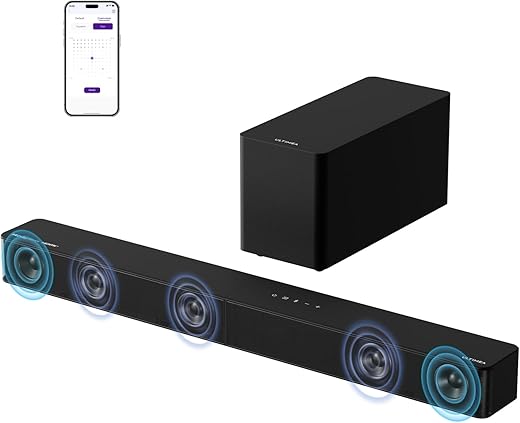
Get Dolby Atmos, BassMX and a 10‑band app EQ in one box — powerful center clarity, but virtual surround has its limits.
If you want cinematic, room-filling sound but don’t have the time, space, or patience for a full multi-speaker rig, you know how often you end up with muddy dialogue, weak bass, or flat imaging. The real pain is getting authentic spatial audio without juggling satellites, amps, and a tangle of cables.
The ULTIMEA 5.1CH Surround Sound Bar with Subwoofer (Poseidon M60) aims to solve that by packing true Dolby Atmos 5.1 processing, wide side-firing drivers, a wired wooden subwoofer with BassMX, HDMI eARC, Bluetooth 5.4, and a 10-band app EQ into a single, integrated system. It promises convincing spatial imaging and punchy low end with granular app control — though the virtual surround is an approximation rather than discrete rear channels.
ULTIMEA Poseidon M60 5.1CH Soundbar with Subwoofer & App

You get an immersive, feature-rich Dolby Atmos experience without a complicated multi-speaker setup, and the app-level EQ gives you granular control. Expect excellent center-channel clarity and punchy bass—just be aware the virtual surround is a convincing approximation rather than true discrete rear channels.
- Sound Quality & Immersion – 9
- Features & Connectivity – 8.5
- App & Customization – 8.8
- Setup, Build & Design – 8
Pros
- True Dolby Atmos 5.1 processing with wide side-firing drivers for convincing spatial imaging
- Powerful wired wooden subwoofer with BassMX for deep, controlled low end
- Comprehensive app control (10-band EQ, 121 presets) and OTA updates
- HDMI eARC passthrough for lossless multichannel audio and simplified TV integration
- Bluetooth 5.4 for more stable streaming and lower latency than prior generations
Cons
- Virtual surround can’t fully replace discrete rear satellites in large rooms
- Some users report intermittent Bluetooth artifacts under certain conditions
- Wired subwoofer limits placement flexibility compared with wireless subs
Detailed Technical Overview
The Poseidon M60 brings a compact 5.1 Dolby Atmos playback chain into your living room, combining five built-in drivers in a single soundbar with a dedicated wired wooden subwoofer. The system is engineered to deliver a room-filling soundstage with voice-forward clarity and configurable low-frequency response so you can tailor performance to your room and content.
Key technologies and how they affect what you hear
- Dolby Atmos / 5.1 processing: creates height and side effects with virtualization rather than physical upward-firing or rear satellites. This increases immersion for object-based tracks while keeping installation simple.
- VoiceMX: a DSP-driven dialog enhancement that isolates and lifts vocal frequencies to keep speech intelligible without cranking overall volume.
- BassMX + 18 mm high-excursion driver: mechanical subwoofer design choices (tuned 5.3L cabinet, high-density magnet) prioritize controlled, low-distortion bass extension to around 45 Hz.
- HDMI eARC: enables end-to-end, near-lossless multichannel transmission at higher bitrates than standard ARC, preserving Atmos metadata and dynamics.
- Bluetooth 5.4: improved stability and interference resistance for streaming sources compared to older Bluetooth stacks.


What you get in the box
1x Soundbar1x Wired wooden subwoofer1x Remote control (batteries not included)1x HDMI cable1x Power adaptor2x Wall brackets and mounting screws1x Wall-mounted kit (4 pieces)
System architecture and room behavior
The bar houses five full-range drivers laid out to produce a wide horizontal image with side-firing elements to simulate surround channels. The dedicated wired subwoofer supplies the LF impact that the compact bar can’t reasonably reproduce on its own. A precision DSP routes channels and applies virtualization to create perceived height and envelopment.
Measurements and practical performance (what to expect)
| Parameter | Practical effect |
|---|---|
| Peak output 300W (system) | Adequate SPL for medium to large living rooms without audible clipping at reasonable volumes |
| Frequency range 45 Hz – 18 kHz | Tight mid-bass and clear treble; you’ll miss sub-40Hz extension typical of larger subs |
| Max SPL ~99 dB | Loud enough for cinematic dynamics in most home setups |
| Subwoofer driver 5.25″ | Punchy mid-bass, less subsonic extension than larger subwoofers |
Setup and connectivity
- Physical: Choose tabletop or wall-mount for the bar; subwoofer connects via the included wired lead—this ensures phase stability and eliminates wireless dropouts from the sub link.
- Digital sources: Use HDMI eARC for the best Atmos experience from compatible TVs and playback devices. Optical is supported for stereo/5.1 downmixed signals but lacks the eARC bandwidth for lossless Atmos.
- Wireless sources: Pair smartphones and tablets via Bluetooth 5.4 for music playback and gaming, but run an initial test in your environment to ensure stable streaming.
App control and tuning workflow
The Ultimea app is where the M60 earns its customization badge. You can:
- Access a 10-band graphic EQ to sculpt frequency response precisely
- Choose from 121 presets and 13 surround levels for quick tuning
- Update firmware OTA to refine DSP behavior and add features
You should use the app for final tuning; hardware buttons or the remote adjust global parameters and can overwrite app-saved profiles, so lock-in your preferred settings in the app.


Listening modes and content recommendations
- Movies: Dolby Atmos content benefits most—object-based effects and height cues are convincing for action and VFX-heavy titles.
- Music: Stereo tracks will sound wide and detailed; use custom EQ for bass-heavy genres to avoid boomy low end.
- Gaming: Low-latency Bluetooth plus tactile sub response supports impactful gaming audio, but for minimal lip-sync you should use HDMI/eARC when available.
Design, ergonomics, and build
Physically the bar is compact and finished in a wood-based enclosure that balances acoustics and aesthetics. The included wall brackets and screws simplify mounting, and the remote presents direct access to modes and DSP shortcuts. The wired subwoofer increases cabling needs but delivers repeatable performance and phase alignment advantages.
Tips to get the most from the system
- Use HDMI eARC from your TV to preserve Atmos metadata; disable TV-level post-processing where possible to let the bar’s DSP manage spatial rendering.
- Place the wired subwoofer near a wall corner for added LF reinforcement but avoid fully sealed corners that cause boom.
- Save a custom EQ in the app before experimenting with remote adjustments to avoid accidentally overwriting tuned settings.
Limitations and realistic expectations
- Virtualized surrounds are effective but cannot replace a discrete multi-speaker 7.1.4 rig in large rooms or for audiophile-grade imaging.
- Bluetooth artifacts have been reported by some users in high-interference environments; use wired/HDMI connections for critical listening.
- Wired subwoofer restricts placement freedom and may complicate furniture layouts.
Final technical takeaway
If you want a technically capable, tunable 5.1 Atmos-capable soundbar that prioritizes center-channel clarity, configurable DSP, and a controlled, musically useful subwoofer, the Poseidon M60 is a compelling mid-market option. It gives you access to advanced features—eARC, granular EQ, OTA updates—normally reserved for higher-priced systems, while keeping setup straightforward and cable clutter minimal.
FAQs
Can the Poseidon M60 deliver true Dolby Atmos?
The unit supports Dolby Atmos playback via HDMI eARC, but it virtualizes height and rear channels using side-firing drivers and DSP rather than using physical upward-firing or discrete rear speakers. Expect convincing Atmos effects for movies and games, though it won’t fully match a dedicated multi-speaker 7.1.4 installation.
Should I use HDMI eARC or Bluetooth for best sound?
Use HDMI eARC whenever possible—eARC preserves high-bitrate multichannel audio and Atmos metadata for the most accurate reproduction. Bluetooth 5.4 is convenient for phone streaming but has lower bandwidth and can introduce artifacts in noisy RF environments.
How do VoiceMX and BassMX change the listening experience?
VoiceMX targets midrange frequencies to lift dialogue and reduce masking by effects and bass, improving intelligibility at lower volumes. BassMX optimizes the subwoofer’s excursion and cabinet tuning to deliver tighter, more articulate bass rather than uncontrolled boom.
Is the wired subwoofer a deal-breaker?
Not necessarily. A wired sub ensures reliable low-frequency transfer and phase coherence, which benefits impact and timing. The trade-off is less placement flexibility compared to wireless subs, but you gain consistent performance and no wireless pairing issues for the LF channel.
How important is the app for daily use?
The app is central if you want to fine-tune the sound—its 10-band EQ, presets, and surround-level controls let you dial in room-specific corrections and save profiles. For basic operation you can use the remote, but advanced users will rely on the app.
Will this system be good for gaming and TVs with variable sound formats?
Yes—HDMI eARC and low-latency Bluetooth make it suitable for gaming. For the best sync and full surround benefit, use eARC and configure your game console to output bitstream or Atmos-compatible formats when supported.


