

Want the sharpest HDR punch and fastest upscaling for your console and streaming — Vizio’s contrast muscle or LG’s smarter AI processing: which one earns a spot in your living room?
Choosing a TV for gaming, movies, or tight budgets? This concise comparison helps you decide between the Vizio 55″ M-Series QLED and the LG 43″ UP8000 4K UHD, clarifying display tech, performance, smart features, and which suits your needs best.
Gaming Focused

8.3
You get a high-color, HDR-capable 4K panel with clear advantages for console gaming and upscaling. Expect a competent but occasionally sluggish smart platform and plan to use a soundbar for satisfying audio; also be mindful of mixed reliability reports when considering long-term ownership.
Value Pick

7.3
You get a competent, budget-friendly 4K TV with a clean webOS experience and convenient Magic Remote control. It’s a solid pick for streaming, daily TV, and light gaming, but you should not expect advanced HDR, high refresh rates, or the color depth of premium QLED/OLED panels.
VIZIO M-Series TV
- Picture Quality – 8.5
- HDR & Color – 8.7
- Gaming Features – 9
- Smart Platform & UI – 7
LG UP8000 TV
- Picture Quality – 7.5
- HDR & Color – 7.2
- Gaming Features – 6.5
- Smart Platform & UI – 8
VIZIO M-Series TV
Pros
- Quantum Color QLED panel delivers rich, saturated color
- Strong HDR support including Dolby Vision and HDR10+
- Gaming-focused features: VRR (AMD FreeSync), Auto Game Mode, low input lag
- Full-array backlight and IQ Active processor for upscaling and contrast
- Good value for gaming and HDR-capable content
LG UP8000 TV
Pros
- Strong value proposition with solid 4K upscaling and color for price
- webOS with Magic Remote and ThinQ AI offers intuitive navigation and voice control
- Slim design and efficient processor for everyday streaming and TV
- Good connectivity and app support for mainstream streaming services
VIZIO M-Series TV
Cons
- Some reported reliability issues and occasional firmware/UI instability
- SmartCast UI can feel sluggish and includes bloat/popups
- Built-in speakers are weak — external audio recommended
LG UP8000 TV
Cons
- Native 60Hz panel limits high-frame-rate HDMI gaming performance
- No Dolby Vision; HDR and peak brightness are modest compared with higher-tier QLED/OLED models
- Platform can show promotional content/popups and occasional UI friction
Design, Panel and Display Technology
Physical design and sizing
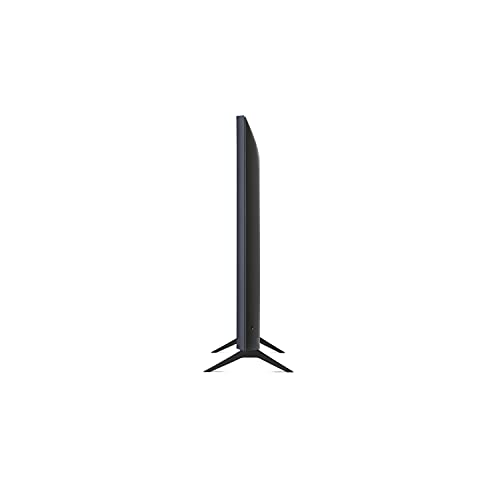
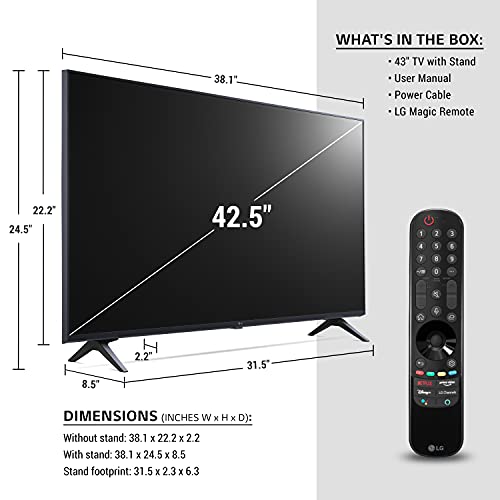
You get two different form-factor approaches: the VIZIO M-Series is a 55″ slab with a slightly thicker chassis to accommodate a full-array backlight; the LG UP8000 is a compact, ultra-slim 43″ set aimed at space-conscious rooms. Vizio’s bezel is modest but handier for a living-room centerpiece; LG’s bezel is slimmer and more TV-on-the-wall oriented. Expect both to use simple two-leg or center stands on Amazon listings.


Panel type and HDR format support
VIZIO: Quantum Color QLED (quantum‑dot enhancement) + full-array LED backlight. Native support for Dolby Vision, HDR10+, HDR10 and HLG gives the M-Series broader HDR metadata compatibility.
LG: 43UP8000 uses an LED LCD panel with characteristics closer to an IPS-style wide-angle panel (native 60Hz). It supports HDR10 and HLG but not Dolby Vision; Filmmaker Mode is included for industry‑accurate playback.
Viewing angles, contrast and peak brightness
Vizio’s QLED + full-array approach yields stronger on‑screen contrast, better localized highlights and higher peak brightness for HDR specular highlights — which matters when you want punchy HDR. LG’s 43″ panel leans toward wider viewing angles but lower native contrast and more muted HDR peak brightness, so HDR “pop” is less dramatic.
Color volume and practical HDR fidelity
Quantum dots in the M-Series increase color volume at high brightness, preserving saturated hues in bright highlights. The LG prioritizes accurate, consistent color and viewing-angle stability with Filmmaker Mode, but it won’t reproduce the same saturated, high‑contrast HDR look you’ll get from Vizio’s QLED.
Performance: Picture Quality, Motion and Gaming
HDR, contrast and color behavior
VIZIO M-Series: With a QLED quantum‑dot layer and full‑array backlight (local dimming), you get stronger contrast, deeper blacks and higher HDR peak highlights. Dynamic formats (Dolby Vision, HDR10+) allow scene‑by‑scene tone mapping, so specular highlights retain detail instead of clipping — out‑of‑box color is punchy and often saturated; you may want a slight gamut/brightness trim for accurate skin tones.


LG UP8000: The 43″ IPS‑style 60Hz panel delivers wider viewing angles but weaker native contrast and no Dolby Vision. HDR10 tone mapping is more static, so bright highlights look less impactful. Filmmaker Mode aims for accurate color and grayscale tracking out of the box, making grading and shadow detail more faithful without aggressive processing.


Motion handling, dejudder and gaming
Motion: LG’s TruMotion interpolation (advertised as TruMotion 120 on a 60Hz panel) reduces judder but can introduce soap‑opera smoothing; you can disable it to preserve film cadence. Vizio’s processing plus the IQ Active engine keeps motion crisp and minimizes judder without over‑smoothing.
Gaming and input lag: Vizio emphasizes ultra‑low input lag and supports VRR with AMD FreeSync, which eliminates tearing and smooths frame pacing on compatible consoles/PC GPUs — a clear advantage for variable‑frame titles. LG’s Game Optimizer gives useful presets and ALLM-friendly behavior, but the native 60Hz panel limits benefits for high‑FPS modes and high‑refresh gaming beyond 60Hz.
- Best for competitive/fast‑paced gaming: VIZIO (VRR + lower lag)
- Best for cinematic fidelity and accurate out‑of‑box viewing: LG (Filmmaker Mode on 60Hz)
Feature Comparison
| Features | VIZIO M-Series TV | LG UP8000 TV |
|---|---|---|
| Screen Size | 55 inches | 43 inches |
| Panel Type | QLED (Quantum Color) | IPS / LED (UHD) |
| Native Refresh Rate | 60 Hz (VRR supported) | 60 Hz (no native VRR) |
| HDMI Ports | 4 HDMI inputs | 3 HDMI inputs |
| HDMI 2.1 Support | Partial (select features/ports expose HDMI 2.1 functionality) | No (HDMI 2.0 features) |
| VRR Support | Yes — AMD FreeSync compatible | No (limited variable refresh functionality) |
| Dolby Vision Support | Yes (Dolby Vision Bright Mode) | No (supports HDR10, HLG) |
| HDR Formats Supported | Dolby Vision, HDR10, HDR10+, HLG | HDR10, HLG |
| Local Dimming | Full-array backlight (limited dimming zones) | Edge-lit / no local dimming |
| Peak Brightness | Higher peak (approx. 500–600 nits typical in HDR scenes) | Moderate peak (approx. 250–350 nits typical) |
| Smart Platform | SmartCast (Chromecast & AirPlay built-in) | webOS with LG ThinQ AI and Magic Remote |
| Voice Assistants | Alexa compatibility; AirPlay/Chromecast support | Alexa built-in; Google Assistant compatibility; AirPlay 2 |
| Gaming Features | VRR, FreeSync, Auto Game Mode, low input lag | Game Optimizer, ALLM; limited for 4K high-refresh gaming |
| Input Lag (typical) | Low (~10–13 ms at 60Hz) | Moderate (~15–20 ms at 60Hz) |
| Audio Output | Built-in speakers; eARC support; soundbar recommended | Built-in speakers; basic audio; eARC/pass-through varies by model |
| Model Year | 2022 (M55Q6-J01) | 2021 (43UP8000) |
| Approximate Price | $$ | $ |
| Weight | 29.7 pounds | 19.2 pounds |
| Dimensions (WxHxD) | 38.9 x 30.5 x 10.9 inches | 38.1 x 24.5 x 8.5 inches |
| USB Ports | USB ports available (media playback) | USB ports available (media playback) |
| Ethernet / Wi‑Fi | Ethernet port and dual-band Wi‑Fi | Ethernet port and dual-band Wi‑Fi |
| Bluetooth | Bluetooth audio support | Bluetooth support |
| Warranty (standard) | Manufacturer limited warranty (typically 1 year) | Manufacturer limited warranty (typically 1 year) |
Smart Platform, Connectivity and Ecosystem
Smart OS and app/casting behavior
You get two different philosophies: Vizio’s SmartCast focuses on built‑in Chromecast and AirPlay support for casting from mobile apps, while LG’s webOS + ThinQ AI centers on an app launcher and the Magic Remote for direct navigation. SmartCast exposes Chromecast/AirPlay natively (great for phone-first workflows) but can feel slower and sees less frequent, smaller UX updates. webOS is snappier, has fuller native app support, and puts Filmmaker Mode and picture presets front‑and‑center in the UI.
Voice assistants and ecosystem integration
- Vizio: Alexa compatibility plus Chromecast implies Google Assistant support via casting; you can use AirPlay with Siri for Apple ecosystems.
- LG: Built‑in Alexa and native Google Assistant support through webOS/ThinQ; Magic Remote voice input is more integrated for TV functions and smart‑home control.Filmmaker Mode on the LG is easy to toggle from picture presets; on the Vizio you’ll toggle picture modes but won’t get the same single‑button Filmmaker toggle.
Ports, Bluetooth and network
- Both TVs support Bluetooth audio (Vizio specifically lists Bluetooth headphone mode).
- Both stream over Wi‑Fi; use Ethernet when low latency matters for gaming/streaming.
- Both include multiple HDMI inputs and at least one HDMI ARC for soundbar connection. eARC availability can vary by model/size — verify the exact SKU if you need high‑bit‑rate passthrough for Dolby Atmos.
Pick Vizio if you prioritize casting/phone workflows and gaming overlay; pick LG if you want a faster UI, integrated voice control, and easy Filmmaker Mode access.
Value, Use Cases and Practical Recommendations
Pricing & long‑term ownership
The Vizio M-Series (55″, 2022) sits around $430 on Amazon; the LG UP8000 (43″, 2021) runs ~ $284. Expect the Vizio to trade at a higher tier due to QLED/Dolby Vision and gaming features; both frequently see $50–$120 discounts during Prime Day/Black Friday. Manufacturer warranty is typically 1 year; on Amazon you can add 2–5 year Protection Plans to reduce out‑of‑pocket risk—factor that into total cost. Vizio’s 2022 model offers newer panel/gaming features but has isolated firmware/reliability reports; LG’s older 2021 SKU is simpler and consistently supported by webOS.
Scenario recommendations
- Movie‑focused: Choose Vizio for Dolby Vision, QLED color and full‑array backlight if you want richer HDR in a living room.
- Console gaming: Choose Vizio — VRR (AMD FreeSync), low input lag and Auto Game Mode make it the better gaming platform.
- Casual TV / streaming: Choose LG for lower price, snappier webOS navigation and Filmmaker Mode for straightforward watching.
- Secondary rooms (bedroom/kitchen): Choose LG for smaller size, lower cost, and easy remote/voice control.
Pros / Cons
Vizio M-Series (55″)
Pros:
QLED + Dolby Vision + HDR10+; full-array backlight; VRR/FreeSync; strong upscaling
Cons:
Higher price; occasional firmware/UI issues; weak built‑in speakers
LG UP8000 (43″)
Pros:
Better value for everyday streaming; webOS + Magic Remote; Filmmaker Mode; slim design
Cons:
60Hz native panel (limits high‑FPS gaming); no Dolby Vision; modest HDR peak
Factor in sale timing, whether you’ll add a soundbar, and whether extended coverage matters to your budget and peace of mind.
Final Verdict — Which Should You Buy?
If you prioritize QLED color volume, Dolby Vision/HDR10+ support and low-latency VRR for consoles/PC, the Vizio M-Series is the clear winner for overall picture and gaming performance. Overall, Vizio edges out LG for pure performance and value.
Pick the LG UP8000 if you need a compact, reliable 4K smart TV with Filmmaker Mode and broader webOS app support at a lower price. Cinephiles: choose Vizio for richer HDR; Gamers: choose Vizio for VRR and FreeSync; Budget/compact buyers: choose LG UP8000 for value and streaming convenience. Ready to upgrade your living room or gaming setup?


